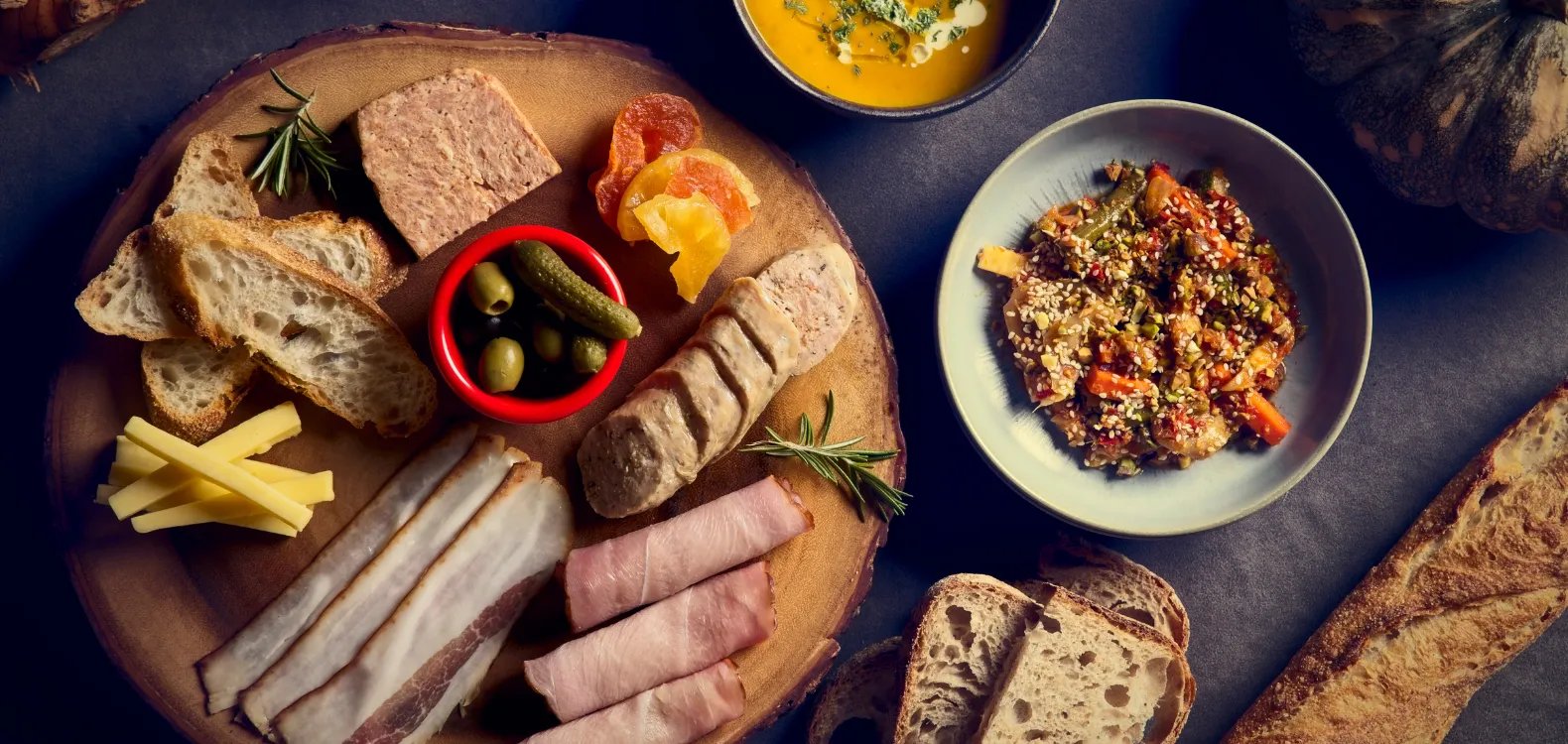
Our signature was the in-house charcuterie, and it belonged to Mr Kuan, my charcuterie expert. He cured, smoked and aged everything on the board: smoked ham, smoked bacon, cured loins, pâté en croûte. A bouchon is a charcuterie house before it is anything else. In Kuala Lumpur there was no supplier working at the level I wanted, so we built the programme ourselves.
Mr Kuan's board of cured pork, smoked bacon, pâté, cheese and sourdough. Photograph: Bonnie Yap.
His ham and bacon ran right through the menu. The carbonara used his bacon and the fried rice used his ham. The donabe rice pots, made with dark Sarawak heritage rice, were finished with smoked pork belly that had spent three weeks in his cure. In practice the kitchen ran to his curing calendar, and we wrote the menu around it.
Pork chop on the bone, house-aged, with chimichurri and fruit chutney. Photograph: Bonnie Yap.
The pork chop was the centre of the room. Cut on the bone, dry-rubbed, aged in Mr Kuan’s cabinet and finished over fire, it came with a tabbouleh chimichurri, crisp pork-rind fingers and a fruit chutney to cut the fat. A Lyonnaise plate, seasoned the way my grandmother would have done it.
Glazed pork belly with a sticky dark glaze, sesame greens and shoestring fries. Photograph: Bonnie Yap.
The glazed pork belly was the most plainly Malaysian thing we served. A clean square of belly, lacquered in dark soy and honey, read as char siu to half the room and as laquage to the other half. Sesame green beans on the side. Shoestring fries, because every bouchon serves something with frites.
Chicken liver parfait, port-wine jelly and charred sourdough, the bouchon's opening plate. Photograph: Bonnie Yap.
The parfait was on every starter board. Chicken liver worked smooth as silk, sealed under a clear layer of port-wine jelly that gave way as soon as the toast went in.
Our sourcing started with Langit Collective, the Malaysian social enterprise that works with smallholder farmers in East Malaysia and brings their heirloom produce to market at a fair return. We chose them on purpose. The rice was theirs, and so was the peppercorn. The golden coral snails, a rare highland variety farmed by Sarawak smallholders, also came through them, onto a Lyonnaise plate that would normally have called for Burgundian escargot.
Sarawak dark heritage rice with smoked pork belly, scallions and pork crisp. Photograph: Bonnie Yap.
Heritage rice over arborio, Langit peppercorn over a generic grind, golden coral snails over escargot: those choices were about telling the truth on the plate, about where I was cooking and for whom. A Lyonnaise bouchon in Kuala Lumpur, supplied from East Malaysia, run by a chef whose grandmother taught him how to read a market.
Herb risotto of Sarawak heritage rice, deep parsley green, crisp pork. Photograph: Bonnie Yap.
We made a Lyonnaise risotto, slowly, with Langit’s heritage rice. The long, dark grain finishes earthier than arborio, and it took the green of fresh parsley the way paper takes ink. Puffed pork rind on top for crunch. On the plate, it made the case that Sarawak rice belongs in a French repertoire just as it belongs in a Sarawakian one.