
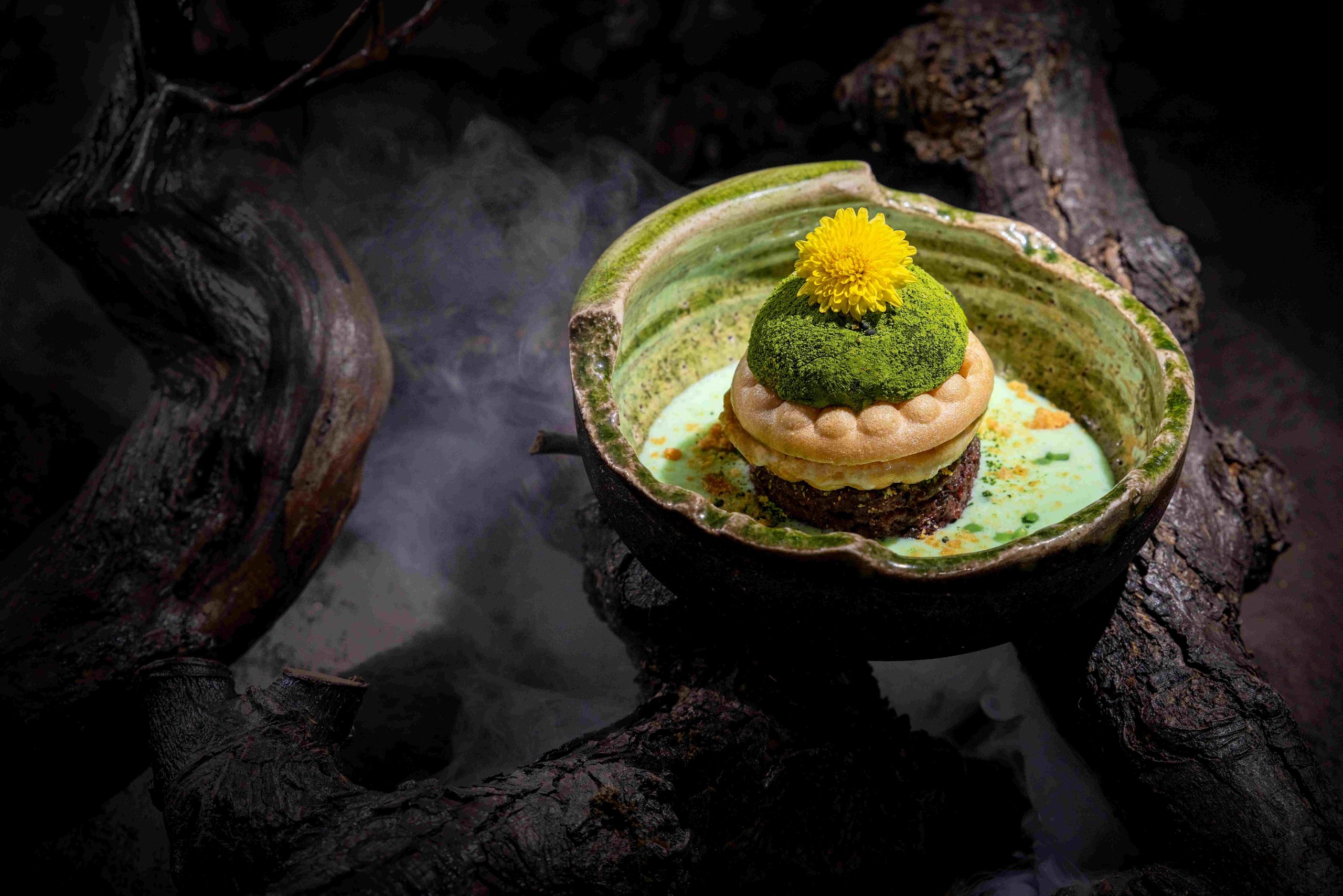
Harmony, the closing course at Expo 2025 Osaka.
French Borneo
French technique and modern precision, in the service of what Borneo's communities have always known.
French Borneo is my cuisine. It is how I cook every plate I put my name to.
James Won
It is French technique, placed in the service of Sarawak’s ingredients and of the thirty-four communities who keep them. It did not arrive in one step, and it is still being learned. Its flavour begins with the stock, and six principles hold it together: technique, the science of the ingredient, conservation, flavour memory, the glass, and research.
The name is recent. The cooking behind it is the work of a career, one dish at a time.


The turn came with Discover Rarity, cooked with Johnnie Walker Blue Label at Enfin from November 2019 to March 2020. Everything beneath the whisky was Malaysian: T’lur caviar from Tanjung Malim, heirloom rice from Borneo, cocoa from the Semai, Job’s tears from Sarawak. It left me with a question I have not put down: what keeps Borneo’s people strong and alive today. That question led to Sarawak, and to Serumpun Sarawak.
French Borneo is a conversation between two complete traditions. The technique that builds the plate is French: sauces on proper foundations, pastry by ratio, a brigade that holds through service. The ingredients, and the knowledge of how to grow, gather and prepare them, belong to Borneo. Neither is softened to make room for the other, which is why I do not call it fusion.
The French side of this work has been recognised with two honours: the Ordre des Coteaux de Champagne (2014) and France’s Ordre du Mérite Agricole (2024). The research behind the Borneo side is done by the Borneo Cultural Museum and the Sarawak Biodiversity Centre, and Professor Gerard Bodeker verifies and supervises the narratives.
Flavour in French Borneo begins with the stock, or the dashi. It is the first thing I would judge in another cook, and the first thing I ask to be judged by.
Mine draws on three kitchens. From France comes the chicken, for body, depth and the unctuous layers a stock is built on. From Japan comes kombu, for its deep umami, and kiku, the Japanese chrysanthemum, for a floral, bittersweet note. From Borneo comes the way the jungle fowl is roasted over raw coals to burn away its feathers, which gives the stock its primal flavour.
The kiku is where the stock is tested. Bitterness in a stock is usually a fault, the sign of over-reduction or of kombu left to boil. Here a trace of it has to sit in balance with the umami of the kombu, the sweetness of the kiku and the body of the chicken. Holding that balance is the finesse I work for.

Mountain, for the Bidayuh: aged venison in a Litsea cubeba crust, three-coloured Bario rice risotto, Expo 2025 Osaka.
I am often called a technician. I take it as a responsibility. Technique is what lets the hundredth plate leave the pass as the first one did, and when it is right the guest notices none of it. They taste the ingredient.

France gave me the foundations, and Japan taught me restraint. Shin’Labo was where the two sat closest together. A course should leave the table while it is still wanted.

Caviar, egg white and sourdough crust, for the Krug degustation at Enfin.
Before I cook an ingredient, I want to understand it: what heat and water do to it over time, and why its community prepares it the way it does.

A precise temperature or a gel is only a tool. It earns its place when it keeps the ingredient’s character, and what generations have known about it, intact. If a technique only impresses, it comes off the plate.

Forest, for the Iban: bichotan-roasted chicken glazed with Gula Apong, Bario cinnamon and Ipa' Kayu, Expo 2025 Osaka.
The other principles rest on this one. The knowledge of Sarawak’s thirty-four communities is the source of this cuisine, and it remains theirs.
Ingredients reach my kitchen through relationships of trust and consent. The community is named when its food reaches the plate, and what it asks to keep private stays private. The record is kept in public, in the Living Pantry and the Serumpun Codex. Little is wasted: the peel becomes broth, and the bone is rendered.

Sea, for the Kayan: tiger prawn wrapped in daun bungkang, hearth-roasted, in Buah Kulim bisque, Expo 2025 Osaka.
A meal is not over when the plates are cleared. It ends years later, when an aroma brings a guest back to the table, the season, and the people who sat with them. Smell reaches the parts of the mind that hold emotion and memory more directly than any other sense, which is why a kitchen can reach so far.

My own cooking began there. The hawker risotto at Enfin put three hawker flavours into Bario rice, so that eaten together they became nasi lemak. In Hakka yong tau foo the chilli is the vessel for the farce. For Krug × Pepper I used an Oaxacan chilli in place of an Asian one. I still read every menu by flavour before I cook it, in the Atelier of Affinities.

The Macallan at the Shin'Labo counter.
For me a meal is not complete without the glass. The drink is planned with the food from the start of a menu, and a pairing without alcohol is given the same care as one that is poured. I pair by contrast and by complement, and it is the practice I hold to most closely: match the weight, bridge an aromatic family, or cut a richness.


Where the food asks for it, the glass comes from Sarawak: tuak, forest-infused mead, nipah-palm cider and toddy, a torch-ginger kombucha. I learned this beside the great houses. At a Krug Chef’s Table, the wine sets the pace as surely as the kitchen does.
Before a recipe is written, the ingredient is studied: where it grows, who keeps its knowledge, and what both the science and the community say of it. Krug’s Single Ingredient briefs work the same way: one ingredient, studied, then cooked.

Two working aids carry the research into the kitchen. PARA, the Proprietary Agentic Restaurant Architecture, takes a menu from first idea to final cost in one guided sequence. CADI, the canon within it, checks each pairing against published flavour science, credits each community, and stops any claim it cannot source. Written down, the method can be taught, and it can outlast me.

Every menu passes through eleven named stages, from the constraints of the occasion and the drinks, through the arc of the courses, the recipes and the pairing, to a final check, the plating, the market list and one written record. Naming them keeps the discipline from slipping when I am not in the room.

On the plate, empty space is part of the composition. There are no more than three garnishes, and every flower must bring aroma, lift, sweetness, freshness or cultural identity, never colour alone. A few lines are never crossed: no veal or pork at public occasions, stock bases kept to their own class, alcohol declared with a dry path ready, and no figure written that the source does not give.

In August 2025 French Borneo was served at Seaside Studio CASO, alongside Sarawak Week at Expo 2025 Osaka, with Professor Gerard Bodeker explaining the science behind each course. It was the international premiere of a full menu driven by Borneo. The Osaka chapter has every course.
The guides that judge kitchens ask much the same of any cook. Michelin looks for ingredient quality, mastery of technique, harmony of flavour, the chef’s personality and consistency. Its Green Star, and The World’s 50 Best Restaurants’ Sustainable Restaurant Award, ask how a kitchen treats the land and the people its food comes from. I would rather French Borneo were held to those questions than excused from them.
If a guest remembers the dish, the people it came from, and who they shared it with, the cooking has done its work.
On the record
“Chef James Won is a master and a culinary innovator, sharing curated wisdom from his training and experience in Japan and France, and drawing on the rich and diverse food heritage of his home country, Malaysia, including from its ancient indigenous traditions.”
Questions answered
What is French Borneo cuisine?
French Borneo is the cuisine of Chef James Won: contemporary French technique, grounded in the science of each ingredient, used in the service of Sarawak's ingredients and the knowledge of its thirty-four ethnic groups, with each community credited for what it shares. It is the cooking at the centre of Serumpun Sarawak.
Where did French Borneo cuisine begin?
In the dishes before the name: James Won's Krug Single Ingredient dishes from 2016, the Krug Chef's Table at Enfin, Krug × Pepper in Oaxaca in 2019, and Discover Rarity with Johnnie Walker Blue Label, which turned his attention to Borneo. Its international premiere, a full menu driven by Borneo, was at Expo 2025 Osaka.
Is French Borneo cuisine a form of fusion?
No. James Won describes it as two complete traditions in conversation, each keeping its standing. Neither is softened to make room for the other.
How is flavour built in French Borneo cuisine?
It begins with the stock or dashi, which James Won regards as the truest test of a chef. His draws on three kitchens: chicken for body and depth (France), kombu for umami and kiku, the Japanese chrysanthemum, for a floral, bittersweet note (Japan), and jungle fowl fire-roasted over raw coals to burn off its feathers, for a primal flavour (Borneo). The skill lies in keeping the kiku's bitterness in balance rather than letting it read as over-reduction.
What are the principles of French Borneo cuisine?
Six: technique, the science of the ingredient, conservation, flavour memory, the glass, and research. Conservation comes first: an ingredient reaches the plate only with the consent of the community that keeps its knowledge, and that community is named.
What are PARA and CADI?
The working aids James Won uses to develop French Borneo menus. PARA, the Proprietary Agentic Restaurant Architecture, carries a menu from first idea to final cost. CADI, the canon within it, checks pairings against published flavour science, credits each community, and stops any claim it cannot source.
The French framework gives rigour. Borneo gives soul. The cuisine is the conversation between them.
James Won
Selected Press
- The Borneo Post Serumpun Sarawak Showcases Indigenous Heritage, Cuisine and Culture in International Debut in Osaka Osaka chapter 10 August 2025
- Palate Asia In The Land Of The Hornbills: Experiencing Serumpun Sarawak In Mulu Mulu chapter 23 October 2025
- TTR Weekly Serumpun Sarawak: A Defining Finale in Kuching Kuching Finale 15 April 2026
Each tradition keeps its standing, and each gives the other what it lacks.