
Ideology
This is the practice as I have come to it so far. A few notes for anyone who reads this far.
Journey of the senses
I cook for the senses: the five everyone knows, and a sixth I have learned to trust.
Sight. Sound. Smell. Touch. Taste.
And the mind.
A dish that stays in the mind after the plate is cleared is where the memory lives. That is where the magic of every creation does its work. The press has been kind enough to call this the journey of the senses. I borrow the phrase only because it is clearer than anything I have come up with. The first five senses serve the moment, and the sixth keeps what lasts.
A meal that feeds the five senses is well made. A meal that feeds the sixth is remembered.
The Atelier of Affinities
If the senses are the why, this is the how. Before I cook a menu, I read it as a sky.
I call it the Atelier of Affinities. The hero ingredient is a sun and its aroma families are the vocabulary. Each course is a small constellation, linked to the sun by the one note they share. Read across it and you read the meal: where it rises, where it holds back, and the moment it is finally allowed to resolve.
This is how I find the sixth sense before the first plate is made. It shows me where a flavour will land in the memory, and how one course will call to the next. The science underneath is real, and cited. The affinities I draw across it are mine: a chef’s reading, open to change on the next pass, and never a formula.
The first galaxy I drew this way was durian, for the table of the Ambassador of France: two fruits used as two, five movements, and the sweetness kept back until the last. You can move through it below by tapping a sun or a course.
The Atelier of Affinities: durian, the first galaxy. Open full screen →
Restraint, in plain terms
Restraint means saying what is true and stopping there.
A spoonful of broth that does not need salt. A dish that arrives without explanation. A photograph cropped to what matters. A line struck from a paragraph because it had nothing to add.
I am still learning this. Patience does not come with the years. I have to earn it again at every service.
What came before
Every plate I send out is in conversation with a lineage I did not invent.
Contemporary French technique with Modernist methods. Japanese seasonality. Malaysian terroir. The thirty-four indigenous communities of Sarawak, whose seeds and plants carry knowledge older than any kitchen I have stood in.
I have studied with chefs whose names are theirs to share, and I leave that to them. The relationship matters more to me than the credit.
There are three mentors I name publicly.
H.E. Tsem Rinpoche of Kechara House and Master Jeff Chew of Bodhicitta Buddhist Association are my spiritual teachers. From them I learned to listen first, to treat gratitude as a discipline, and to take the same care when nobody is watching.
My grandmother is the third. She taught me that food is love made visible, and that the kitchen is where care passes from one generation to the next. The three teachings sit close together, and I keep all of them at the centre of the work.

Where I cook from
I cook from Borneo more than from any one kitchen.
The rainforest, the river, the village ground.
The communities are makers, and I do not treat them as subjects to celebrate. They hold the seeds, the medicine, the seasons and the ceremonies, knowledge older than any record I could keep. My job is to listen first and cook second. Sometimes the cooking is small. Sometimes I listen for a whole season before a single dish is made. Both are the work.
The terroir we live on
Hyper-localism, for me, is the discipline of cooking from where you stand: from the soil within reach, from the seasons as they come, from makers you know by name. I have never treated it as a marketing line.
Zero waste is simply how any kitchen that respects the ground works. The peel becomes broth. The trim becomes fond. The bone is rendered, the seed replanted, the leaf returned to compost. Nothing leaves the kitchen by accident.
We watch the carbon weight of every plate, because a kitchen that takes the ground seriously does that without being told. Ingredients travel the shortest distance the work allows. The maker is paid what the work is worth. The terroir we live on is the terroir we serve from.
The Kuching Finale of Serumpun Sarawak was the whole practice in one evening. Sarawak Cultural Village grew the garnishes, the vegetables and the forest varietals on the grounds where we served. Tuak was brewed on the premises for the presentation night, and the rest of the proteins came from SEDC’s subsidiary and farm. The Sarawak Cultural Village team foraged the tablescape itself from the edible fruit and distinctive flora of Santubong. Nothing travelled further than the work needed.
Every dish that evening was cooked over firewood from fallen trees on the grounds. There was no gas and no electricity. The kitchen ran on fire alone.
None of this is new. Kitchens have always cooked this way when they were paying attention. The modern world has had to learn it again, though the kitchens that never lost the habit still remember it.

The dish
What lands on the plate is the practice.
My own preferences stay off the plate. I read the maison’s discipline through my hand.
Krug, Hennessy, Mortlach, Johnnie Walker: each has its own voice, and centuries of patience that I am the latest in line to honour. My work is to listen to that voice and then cook to it.
The dessert in the photograph is one I keep coming back to. I created it for Johnnie Walker Blue Label and it is still one of my favourites, both for what it taught me about craftsmanship and for how much of the ground I work from it holds.
Every element comes from Malaysian terroir. Award-winning Batang Kali Single Origin chocolate. Jobs Tear, the pearl-grained heritage cereal that has fed Southeast Asian tables for generations. Meringue made with roselle powder, for the tropical pink that Sarawak knows better than any palette. Eggs from free-range, happy chickens kept nearby, the way eggs were always meant to be. And the mousse, light as air, infused with the Blue Label itself.
It works because every part of it is honest: to the maison whose voice the dish speaks in, to the ground the ingredients came from, and to the makers who did the work long before it reached my hands (the chocolatier, the egg farmer, the roselle grower, the keeper of the Jobs Tear).
The food is real. Guests savour it, take their time with it, and come back to it in memory. The art lives in that return, in the moment days later when a flavour or a gesture comes back without being called. That is the sixth sense at work, and it is what a kitchen is for.

The hands
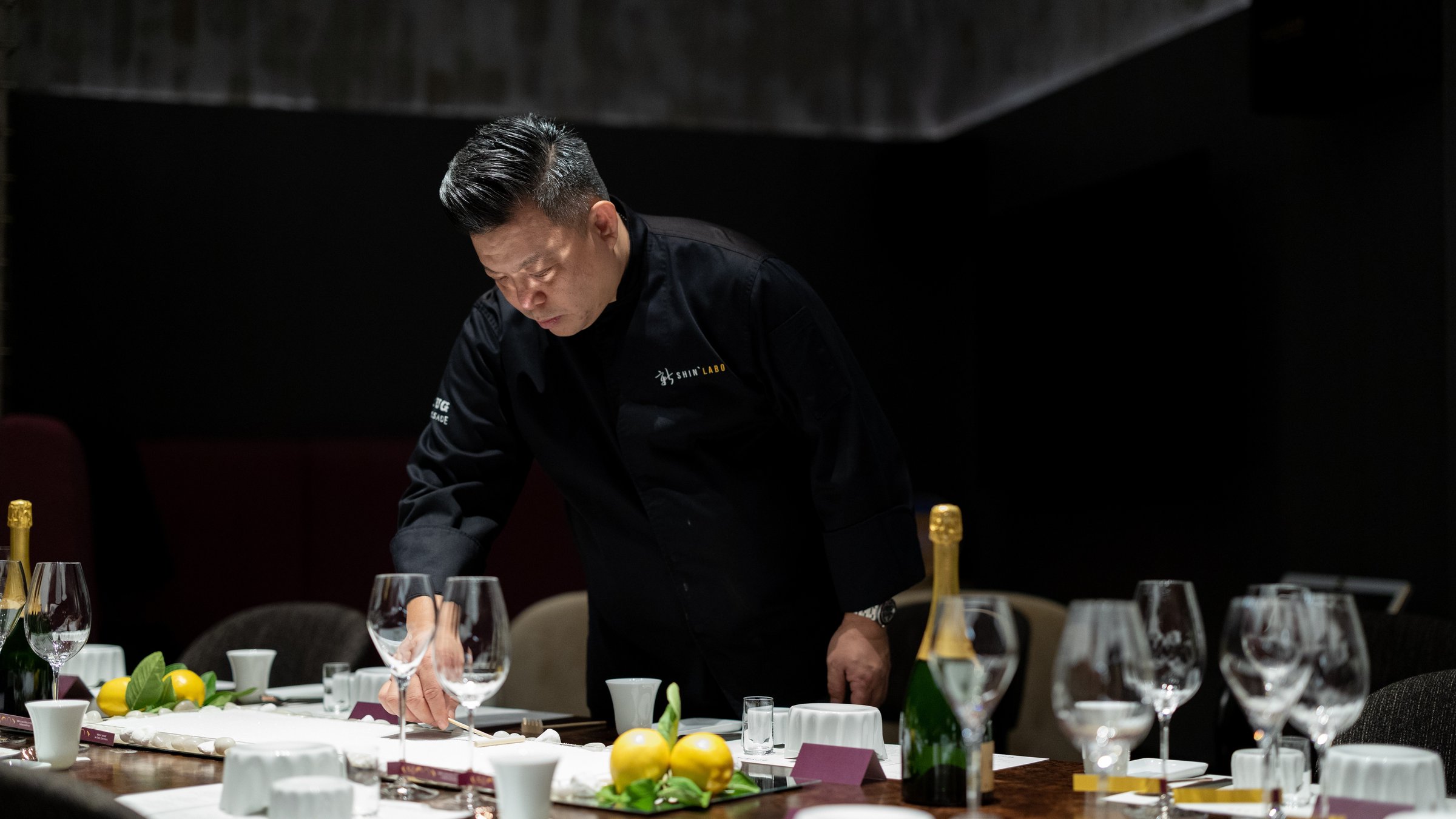
The hands do the work. They carry a patience that sentences cannot.
Some knowledge lives in the hand and never reaches language. It shows in how a knife meets the board, how a sauce is checked without tasting, how a plate is set down. Years of service teach the hands more than the head. I trust them.
What endures
The plate is cleared. The room is reset. The next service begins.
What I hope lasts is the memory, the sixth sense that stays in the mind. A guest who goes back to the moment in their own time. A community whose work was honoured in full. A discipline handed on, quietly, to whoever picks up the work next.
That is the magic of cooking: it disappears into memory, and the plate makes no secret of it.
The food is gone within the hour. The work, if it was done well, lasts much longer.
Questions answered
What is James Won’s cooking philosophy?
James Won cooks for the five senses and a sixth: the memory a dish leaves behind. His method is contemporary French technique with Modernist methods, Japanese seasonality and Malaysian terroir, in service of Borneo’s ingredients and the knowledge of Sarawak’s thirty-four indigenous communities.
How does James Won practise hyper-localism and zero waste?
He cooks from where he stands: from the soil within reach, the seasons as they come and makers he knows by name. The peel becomes broth, the trim becomes fond, the bone is rendered and the seed replanted. At the Serumpun Sarawak Kuching Finale on 2 April 2026, the garnishes were grown at Sarawak Cultural Village and every dish was cooked over firewood from fallen trees, with no gas and no electricity.
How is the Atelier of Affinities connected to this philosophy?
The senses are the why and the Atelier of Affinities is the how. Before cooking a menu, James Won reads it by the aroma families its ingredients share, to find where a flavour will land in the memory and how one course will call to the next.
Who is this page for, and how can I bring the approach to my table?
This page is for diners, students, chefs and partners who want to understand how James Won cooks. To bring the approach to a dinner, a classroom or a collaboration, write to connect@chefjameswon.com.
What I hope endures is the memory. A dish that stays in the mind after the plate is cleared is where the magic lives.
James Won
I am still walking, and have not arrived. I am listening, and leave the speaking aside. The practice goes on, one service at a time.