
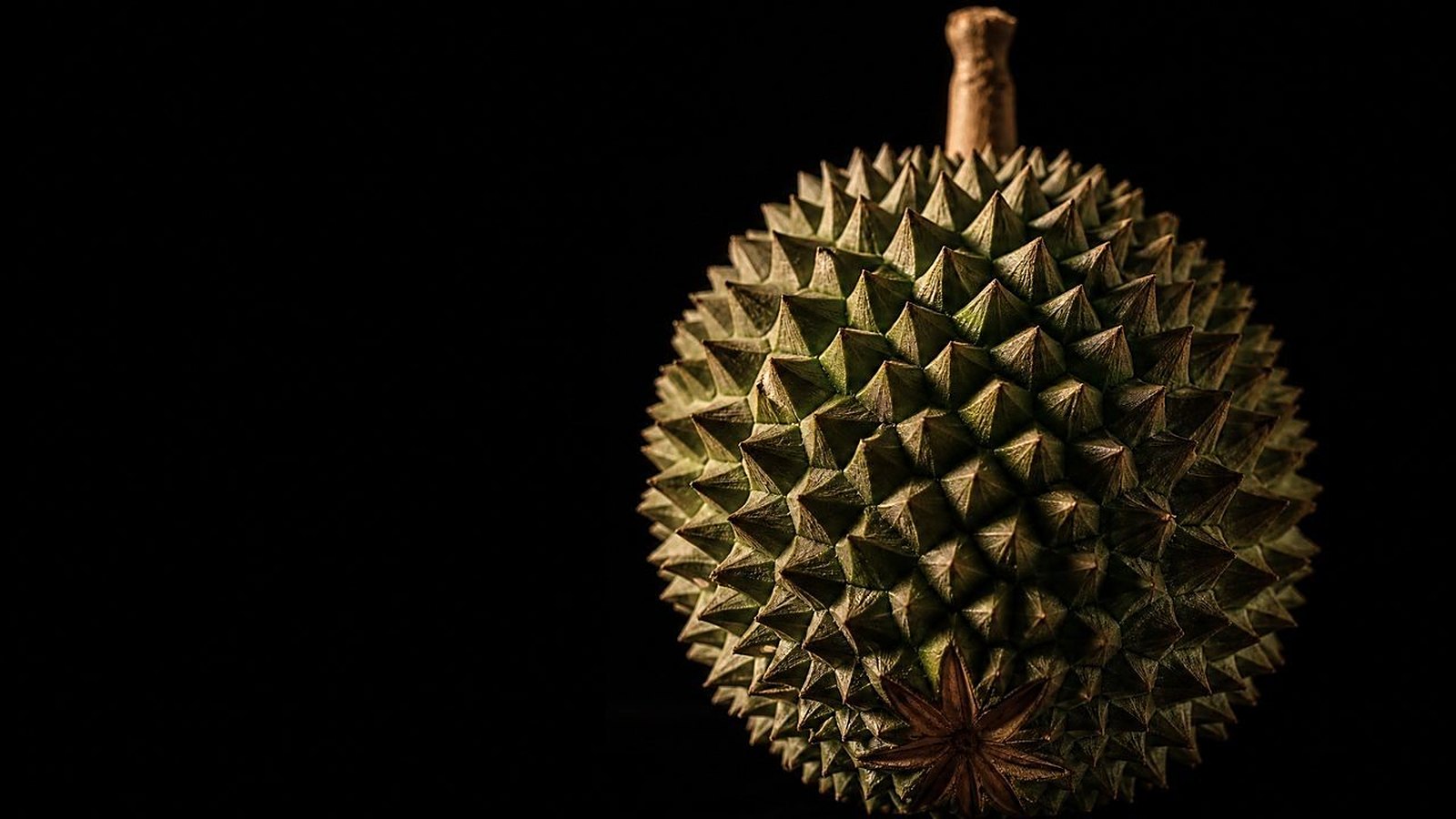
Durian, in five movements
An evening at the table of the Ambassador of France.
On the eleventh of June, the Embassy of France in Malaysia gave a whole day to durian and asked me to cook the dinner that closed it, at the Residence of France, for His Excellency Marc Abensour. One fruit in five movements, each with its own technique. I set a single rule: keep the sweetness back until the very last plate. A French table would meet the king of fruits five times and only know it fully at the end.
The brief, and the danger
The brief was durian: one fruit, a different technique for every course, for the Ambassador’s table. When you carry a single fruit through a whole menu, flavour is the easy part. Fatigue is the risk. Durian is loud, and if the sweet custard most people know came first, the palate would have nowhere left to go.
So I held it back. I moved durian through five states and let its sweetness out only at the very end, so each course met a fruit the guest had not yet tasted. This is what I mean by French Borneo. It is a method, and fusion has nothing to do with it: study an indigenous Sarawak food technology, take the principle inside it, and take that forward with contemporary French and Japanese technique, naming the community’s knowledge at every step.


The five movements
It opened with tempoyak, durian soured under salt until it tastes savoury and no longer like the fruit, set against lightly cured kanpachi and a clear kombu jelly. The ferment is not mine. It belongs to the Malay and Iban kitchens of Sarawak, and it opened the meal by serving the king of fruits in disguise.
Then the fruit as cream, folded fresh into a silken dashi custard with mud crab: comforting, and still savoury. Over fire it turned to toffee, the sweeter Black Thorn caramelised over binchotan beside a seared scallop and a charred lime. In the fourth movement durian almost disappeared into the background of a roast duck, deepening the jus the way a spoonful of miso would, while the vegetables were smoked over the durian’s own spent husk. Nothing of the fruit was wasted. Bario cinnamon, which the Kelabit look after, warmed the sauce.
Only at the end did I let durian be sweet: a frozen Black Thorn parfait with Bario cinnamon and calamansi. After four courses of holding back, the fruit arrived whole. Three palate cleansers sat between the courses (torch ginger and lime, green mango and laksa leaf, lemongrass and pandan). None of them used durian, and each one cleared the way back to it.
The Atelier of Affinities
Before I cook a menu like this, I read it as a sky. I call it the Atelier of Affinities. The hero ingredient is a sun and its aroma families are the vocabulary. Each course is a small constellation, linked to the sun by the one note they share. The science is real, and cited. The affinities are mine: a chef’s reading, open to change on the next pass, and never a formula.


Two fruits, used as two
The map has two suns because we used two durians as two different fruits. Musang King is the loud one, savoury and almost meaty, with a milky richness underneath, and it led the savoury courses: the ferment, the custard, the duck. Black Thorn is the quieter, sweeter sun, with close to double the sugar, and we kept it for the caramel and the final parfait. Where the fruit could not carry a note on its own, as with the toffee depth of the third movement, we built it with palm sugar and fire. Being honest about that is part of the discipline.


Cooked with Taylor’s, kept with Sarawak
We prepared the dinner at Taylor’s Culinary Institute and finished it at the Residence on the day: one sous chef and four final-year students, with the pastry section handling the dessert and the three cleansers by themselves. If a way of working dies with the person who teaches it, it has failed. The point was never one chef and one fruit. It was the next cooks learning to take an indigenous larder forward, with the communities who keep it named at every step and nothing of the fruit wasted.

A bridge, on a plate
The Ambassador told the room it had taken him three attempts at durian, and that the third was a revelation. That is the whole case for an evening like this. Here is a fruit that clears rooms in one country and is barely known in another, and the two meet on one plate. Gastronomy lets two cultures recognise each other through pleasure, and through patience.

Durian divides a room, and that is why it can join two cultures.
James Won


Selected Press
Full archive →- Astro AWANI Durian Malaysia, Durian Perancis — seni gastronomi makanan (#AWANIpagi) 11 June 2026
- Embassy of France in Malaysia The Durian: An Embodiment of Power — French and Malaysian Cross-Cultural Perspectives 12 June 2026
- New Straits Times Durian can serve as cultural bridge between Malaysia and France 12 June 2026
- Free Malaysia Today A French ambassador's thorny love affair 14 June 2026
- The Sun Durian: a cultural bridge between Malaysia and France 13 June 2026
We cook a people's knowledge forward, with their names on it.
James Won